首页»
学术报告
学术报告
学术报告
报告人| Prof. P. Sengupt
南洋理工大学
时 间|2026年4月13日 16:00
地 点|科技楼602
Abstract: The ground state of S=1/2 Heisenberg antiferromagnet on the kagome lattice is widely acknowledged as a paradigmatic models of a quantum spin liquid. Geometric frustration precludes the onset of any long range order and the spins remain fluctuating (liquid-like) down to absolute zero temperature. Instead the state is marked by anomalously high long range entanglement. However, despite numerous studies using both analytical and numerical approaches, the true nature of the ground state and low- energy excitations in this system remain debated. State of the art numerical studies using iPEPS and DMRG give conflicting results, predicting either a gapped Z2 spin liquid or a gapless U(1) Dirac spin liquid. This is because current numerical methods. are fundamentally constrained by the long range entanglement. The recently introduced Neural Network Quantum State (NQS) ansatz promises to overcome many of the bottlenecks and provide unbiased results. We present the results of our investigation of the problem using the Group Equivariant Convolutional Neural Networks representation of NQS – an advanced machine learning technique that has been immensely successful in image recognition problems. The approach, combined with variational Monte Carlo, introduces significant improvement of the achievable results accuracy in comparison with approaches based on other neural network architectures that lack generalization quality for frustrated spin systems. Our results strongly indicate that the ground state of the kagome lattice antiferromagnet is a spinon pair density wave that does not break time- reversal symmetry or any of the lattice symmetries. The found state appears due to the spinon Cooper pairing instability close to two Dirac points in the spinon energy spectrum and resembles the pair density wave state studied previously in the context of underdoped cuprate superconductors in connection with the pseudogap phase. The state has significantly lower energy than the lowest energy states found by the SU(2) symmetric density matrix renormalization group calculations and other methods.
Ref.: Tanja Ðurić, Jia Hui Chung, Bo Yang, and Pinaki Sengupta, “Spin-1/2 kagome Heisenberg antiferromagnet: Machine learning discovery of the spinon pair density wave ground state”, Phys. Rev. X, 15, 011047 (2025).
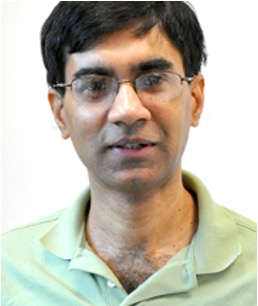
Pinaki Sengupta is a computational many body physicist working on quantum magnetism in low dimensions. He obtained his Ph.D. in 2001 from the University of Illinois, Urbana-Champaign. In 2009 he moved from the Los Alamos National Laboratory in USA to the Nanyang Technological University in Singapore, where he currently works. He works closely with experimentalists to explore complex phases and transitions in quantum magnets by combining simulations of realistic microscopic models with experiments on related materials. Some of his recent research interests include frustrated magnetism, topological magnons, and, most recently, quantum spin liquids.
邀请人:郭文安教授